
'The revenue projection arises out of all sectors doing well and the formalisation of the economy helps in making sure the tax domain gets widened.'
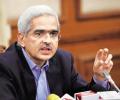
A staunch defender of demonetisation, it would be interesting to see how he handles the government's increasing demand for more cash from the RBI, and letting some weak banks get out of prompt corrective action.

'The selling in India may emerge as soon as the RBI reverses its interest rate stance.'

One incident should not be used to generalise the health of all cooperative banks, says RBI governor Shaktikanta Das.

In a filing to stock exchanges, BoI said Reserve Bank of India has placed it under Prompt Corrective Action Framework, consequent to the onsite inspection under the risk based supervision model carried out for the year ended March 2017.

With Deputy Governor Viral Acharya and another member Chetan Ghate voting for a status quo, RBI governor Shaktikanta Das and three others outvoted them for reduction in repo rate to 6.25 per cent from the existing 6.50 per cent.

'In equities, it has diversified portfolios.' 'So the short-term movement of individual stocks does not impact them.'
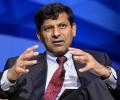
Former Reserve Bank Governor Raghuram Rajan said India will still remain a lower middle country if the potential growth rate remains at 6 per cent annually without any rise in population by 2047 (Amrit Kaal) and will be reaching the end of the demographic dividend by then. Speaking at a programme organised by Manthanon on Saturday, the economist said if the country does not grow faster, it will grow older (demographically) before it gets richer, which means there is the burden of an aging population to deal with also at that point. Rajan said the GDP growth in India for the past two quarters was in the region of 7.5 per cent and if one looks at the labor force participation, it is very low and when it comes to female participation, "it is the lowest in the G20".

The RBI has targeted 6 per cent inflation by January and 4 per cent by March 2018.

To check fiscal deficit, government needs to drastically cut Plan expenditure.
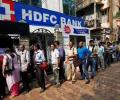
This mean that just Rs 10,720 crore of the junked currency did not return to the banking system.

'We have a plan to plough back a 'This year in the first half we had profits of more than Rs 31,000 crore.' significant amount of profits this financial year.' 'We have seen this organic plough back of profit is one of best ways to support the equity of the bank.'

'The RBI is something like a seat belt. As a driver, the driver being the government, it has the possibility of not putting on a seat belt but of course if you do not put on your seat belt you get into an accident and the accident can be quite severe,' Raghuram Rajan told CNBC TV18. 'The aim of the board is to be Rahul Dravid -- sensible, thoughtful and not, with due respect, Navjot Sidhu,' he added.

Top sources in RBI blamed 'unwarranted rumours' about controls on foreign institutional investors' money to the nearly 770 point drop in the benchmark Sensex and rupee dipping to its lowest levels.

Here are the key decisions announced by the Reserve Bank of India on Thursday.

The deficit stood over Rs 8 trillion in the first seven months of the current financial year. Non-tax revenues, comprising transfers from the RBI and dividends of the public sector units, shored up the Centre's revenues.

Dwaipayan Bose on how index funds play a key role in the diversification of portfolios and help manage risks

The RBI expects change, presumably commencing in the next Budget, but must hold its current view until this actually happens.

Finance Minister Nirmala Sitharaman on Monday said the government has come out with open and transparent Budget and has not made any attempt to hide anything under the carpet.

In order to further enhance customer convenience, and to leverage the 24x7 availability of real-time gross settlement (RTGS), NACH which is currently available on bank working days, is proposed to be made available on all days of the week effective from August 1, 2021, RBI's Shaktikanta Das said.

It also recommended that the RBI accounting year (July-June) may be brought in sync with the fiscal year (April to March) from the financial year 2020-21 as it could reduce the need for interim dividend being paid by the central bank.

The Union government's finances witnessed significant improvement in August after a stressful first four months of the current fiscal year. India's gross tax revenue, comprising both direct and indirect taxes, for the first five months of 2023-24 surged 16.5 per cent year-on-year (Y-o-Y) to Rs 11.8 trillion. During the April-July period, gross tax revenue increased by a mere 2.8 per cent compared to the Budget Estimate of 12.1 per cent growth for FY24.

Only Rs 16,050 crore out of the Rs 15.44 lakh crore of the old high denomination notes have not returned.
Clamping down on the delays in repatriating foreign exchange earnings, the Reserve Bank of India (RBI) has tightened norms for special economic zones (SEZs), asking them to realise and bring back full value of goods and services to India within a year from the date of export.
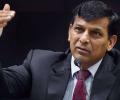
Indian economy, dubbed the fastest growing major economy in the world, is faced with the single most important pressure point of job creation, says former RBI Governor Raghuram G Ranjan as he makes a strong case for improvement of human capital through skill development. Talking about the book 'Breaking the mould: Reimagining India's economic future', written jointly by him and Rohit Lamba, assistant professor of economics at Pennsylvania State University, Rajan said one of the greatest strength of India is its human capital of 1.4 billion and the question is "how do you make it strong?" The nation needs to create jobs at every level going along the path of development, said Rajan, presently Katherine Dusak Miller Distinguished Service Professor of Finance at Chicago Booth, USA.

The immediate revenue loss could worsen the Centre's fiscal deficit, from the budgeted 3.3 per cent of gross domestic product (GDP) to 3.7 per cent of GDP -- a massive 40-basis-point increase. It was stabilised at 3.4 per cent since 2016-17, report Abhishek Waghmare and Dilasha Seth.
To ensure seamless settlement of funds and convenience to investors, Sebi on Thursday said stock brokers should maintain current accounts in appropriate number of banks for holding clients' funds. The clarification comes after Sebi received representations regarding the issue being faced by stock brokers. They requested the regulator to issue instructions in respect of maintenance of current accounts in multiple banks.

In the past three years, personal loans have grown at twice the rate of growth in personal disposable income, leading to a steady rise in household indebtedness. At the end of March this year, Indians owed Rs 25.2 lakh crore to banks and listed non-banking finance companies (NBFCs), up 65 per cent in the past three years.

To further strengthen the supervision on non-banking entities (NBFCs), the Reserve Bank on Tuesday issued revised guidelines on a Prompt Corrective Action (PCA) framework for such companies, excluding government-owned ones, effective from October 1, 2022, on the lines of what it had introduced for banks in 2002. The RBI came up with stricter supervisory norms under the PCA framework for banks after their bad loans mounted and balance-sheets bled badly. This involved restricting them from fresh lending, brand opening and, hiring, among others. The RBI said the revised PCA framework is also applicable to all deposit-taking non-banking financial companies (NBFCs), all non-deposit taking NBFCs in the middle, upper and top layers, including investment and credit companies, core investment companies, infrastructure debt funds, infrastructure finance companies and microfinance institutions.

Sounding a note of caution, former Reserve Bank Governor Raghuram Rajan has said that India is "dangerously close" to the Hindu rate of growth in view of subdued private sector investment, high interest rates and slowing global growth. Rajan said that sequential slowdown in the quarterly growth, as revealed by the latest estimate of national income released by the National Statistical Office (NSO) last month, was worrying. Hindu rate of growth is a term describing low Indian economic growth rates from the 1950s to the 1980s, which averaged around 4 per cent.

A government can't just take away public money, and the RBI can't extinguish its liability. 'The RBI has to honour the value any time a person with legal and taxed money lays claim on the value.'
Analysts believe that investors should look at stocks that hit 52-week lows only if they have a dividend paying track record, are debt-free and have sound fundamentals.

Mann stares at a twin-headed monster: Resuscitating the state's debilitated public-sector enterprises and controlling the spiralling debt to keep the state machinery and his poll-fuelled populist schemes running.

Garg had refused to sign on the report finalised by the former Reserve Bank of India governor Bimal Jalan-led committee reviewing the central bank's economic capital framework (ECF).
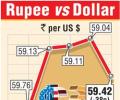
Forex dealers will keenly watch, instead, if the central bank indicates more measures to stabilise the currency or gives a timeframe for its current action.

'In a serious fiscal situation like this, an ostrich-like focus on annual budgeting, event management and defensive rhetoric will only make matters worse,' warns Rathin Roy.

There will be a lot to repair and rejuvenate -- if that opportunity even presents itself, warns Rathin Roy.

RBI proposes tax exemption on dividend payouts and credit for corporation tax paid in host country.


New norms are in place to strengthen regulations for this set of lenders which has been playing a critical role in Asia's third largest economy, notes Tamal Bandyopadhyay.
